
Indian Museum, Kolkata: The City's Must-See Attraction
If there’s one place in Kolkata where you can time-travel from the Jurassic era to colonial India in just a few hours and it’s the Indian Museum. It’s not only the oldest museum in India, but also one of the largest and most comprehensive museums in Asia. You’ll find ancient mummies, fossils, Mughal art, Buddhist relics, meteorites, textiles, sculptures, and more. Whether you’re a history buff, a culture lover, or just looking for an educational experience, the Indian Museum offers a deep dive into the layers of India’s civilizations.
The museum is rate 4.5 on Google and has over 50,000 reviews. As per Wikipedia – It is the ninth oldest museum in the world and the oldest, as well as the largest museum in Asia, by size of collection.
A Timeline of the Indian Museum: From Conception to Legacy
| 1784 | Sir William Jones, a profound scholar, founded the Asiatic Society in Kolkata, laying the groundwork for a new era of cultural and scientific discovery. |
| 1796 | The idea to establish a museum for the preservation of objects of nature and man-made artifacts was first conceived by members of the Asiatic Society. |
| 1808 | The Society occupies its new premises at Park Street, providing a suitable location for the future museum. |
| 1814 | Dr. Nathanial Wallich, a Danish botanist, officially proposed the formation of a museum. Under his guidance, the museum was established on February 2 at the Asiatic Society, with Dr. Wallich as its Honorary Curator. |
| 1816 | The museum begins to grow, with its first recorded gifts of 174 items from 27 European donors. Indian contributors also began to donate objects soon after. |
| 1840 | A museum of economic geology, a precursor to the main institution, was opened in Calcutta. |
| 1856 | The Asiatic Society submits a memorial to the Government of India for the establishment of an "Imperial Museum" in Calcutta. |
| 1865 | The archaeology collection was already being catalogued by John Anderson making it one of the two initial, Art & Natural history, galleries at the museum. |
| 1867 | After years of negotiations, the foundation for the current Indian Museum building was laid on Chowringhee. |
| 1875 | Construction of the new Museum building, designed by W. L. Grandville, was completed. |
| 1878 | The Asiatic Society Museum officially shifted to the new Chowringhee building. It was opened to the public on April 1, marking the birth of the Indian Museum as a public institution. |
| 1904 | Anthropology collection was formally designated as a separate section at the Indian Museum, alongside zoological, geological, and archaeological sections. |
| Today | The Indian Museum has developed into the largest institution of its kind in the country, a pioneering National Institution with six multidisciplinary sections and a testament to India's rich heritage. |
What’s inside?
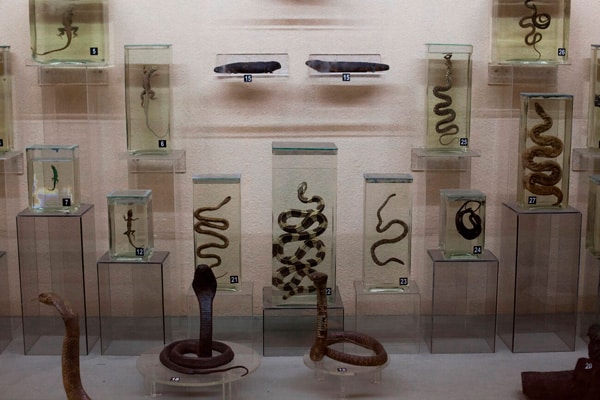
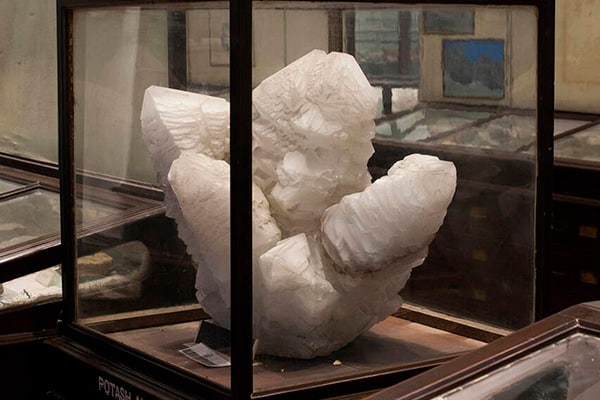
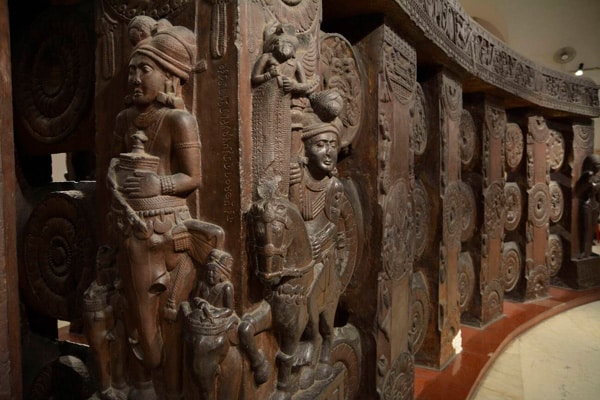
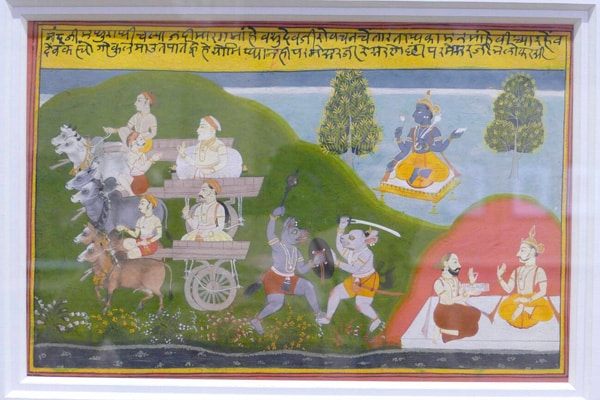
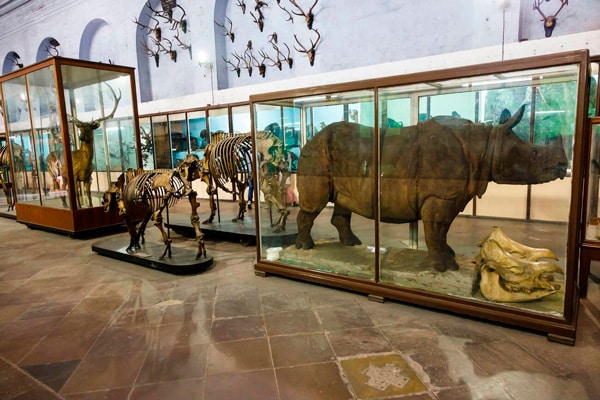
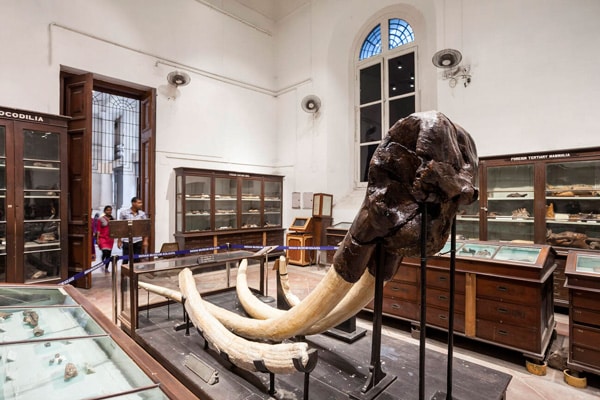
The museum is spread across six main sections and 35 galleries:
1. Archaeology
- Bharhut and Amaravati sculptures from the 2nd century BCE
- Buddhist relics, ancient stupas, and railings from Sanchi
- Rare artefacts from the Maurya, Gupta, and Pala periods
2. Art
- Stunning collections of Mughal miniatures, Rajput paintings, and Bengal School works
- High-quality and diverse textile collection, showcasing India’s rich heritage.
- Decorative arts including coins, textiles, and intricate ivory carvings
3. Anthropology
- Preserves and documents endangered tribal and folk cultures.
- A journey through human evolution, with fossils, ancient tools, and skeletal structures.
- Masks, tools, ornaments, and musical instruments that showcase regional diversity
4. Zoology & Botany
- Stuffed animal specimens, exotic birds, fish, and plants from all over the subcontinent
- Preserved animals in formaldehyde
- Skeleton of a Great Indian Baleen whale
5. Geology & Fossils
- Fossilized trees, dinosaur bones, meteorites, and rare minerals
- The famous Gondwana Fossils and an enormous ammonite fossil
6. Egyptian Gallery
- The showstopper: a real 4,000-year-old Egyptian mummy. This ones a favourite among school kids and first-time visitors. Even in google reviews The Egyptian mummy and the grand Buddhist galleries are particularly fascinating.
Visitor Info:
Location: 27, Jawaharlal Nehru Rd, Fire Brigade Head Quarter, New Market Area, Dharmatala, Taltala, Kolkata, West Bengal 700016
The museum is conveniently located near Park Street Metro, making it easily accessible for visitors. Please note that on-site parking is not available, and finding parking spots nearby can be a hassle so it is highly recommended to visit using public transport or get dropped and picked from the location.
Timing: 10:00 AM – 6:30 PM (Tues-Sun) (closed on Mondays and public holidays)
Entry fees: Adult – Rs.75.00 | Children – Rs.20.00 | Children below 5 years – FREE
It is better to book the tickets online to escape the queue and fast entry. Official tickets can be purchased from – https://store.indianmuseumkolkata.org
Photography: For Camera need to pay separately ₹59 for mobile camera, other cameras like DSLR etc. has separate charge)
Note:
- The Indian Museum is not fully air-conditioned, so visitors in the summer months are advised to wear comfortable, breathable clothing. As a typical visit can take 2-3 hours, wearing comfortable walking shoes is also highly recommended.
- The museum is undergoing phased renovations to modernize its displays while preserving heritage. So some section or galleries might be closed.
- Located just 3.1 km from the Indian Museum, Roland Hotel is considered one of the best budget hotels in Kolkata. With spacious rooms and modern amenities, it is an ideal choice for visitors who wish to stay close to the city’s popular attractions.
Fun Facts
- The museum is nicknamed “Jadughar” or “Ajubaghar” by locals, meaning “House of Magic”.
- It houses over 2.5 million artefacts. Even a full day may not be enough!
- Indian Museum is a National Heritage Site.
- 360° virtual tours are available on the official website and virtual exhibitions via Google Arts & Culture.
Visiting the Indian Museum isn’t just about seeing ancient relics. It’s about experiencing India’s timeline in one curated space. From spiritual sculptures to scientific wonders, and royal artefacts to tribal traditions, this museum doesn’t just preserve history. It makes it come alive. If you’re ever in Kolkata, a visit to the Indian Museum is an absolute must.